
21/01/2026
App promotion has never been easier to start and never been harder to scale.
Launching user acquisition ad campaigns, pushing for new installs, and driving traffic to an app is table stakes. Yet many fintech and e-commerce marketers find themselves stuck in a familiar cycle: rising acquisition costs, inconsistent results, and growth that plateaus just when budgets increase.
The issue isn’t due to lack of effort, bad selection of channels, or even creativity. It’s the absence of a performance system behind the app promotion cycle.
Leading growth teams don’t think about app promotion as a series of campaigns. They treat it as a repeatable, measurable system one that connects media, data, creative, and optimization into a single growth engine. That shift is what separates short-term traction from long-term performance.
App promotion today: more complexity, less margin for error
Modern app promotion operates in a far more demanding environment than it did just a few years ago:
- User acquisition costs are volatile
- Audiences are fragmented across hundreds of media sources
- Data signals are less direct and less forgiving
- Growth teams are expected to show impact beyond installs
For fintech and e-commerce apps especially (but not just these app verticals), installs alone don’t equal success. Quality users, retention, and downstream revenue matter just as much and often more.
In this environment, running disconnected campaigns across channels creates blind spots. Performance becomes hard to explain, harder to repeat, and nearly impossible to scale predictably.
That’s why the best-performing teams change the question from “How do we promote our app?” to “How do we build a app promotion system that compounds performance over time?”
The real reasons mobile app promotion underperforms
When app promotion struggles, it’s rarely due to a single tactic. More often, it’s structural.
Fragmented execution
User acquisition ad budgets are managed independently across platforms and teams, leading to siloed decisions with little visibility into cross-channel performance. Multiple media managers handle different platforms but seldom coordinate, resulting in a fragmented overview.
Short-term optimization
Campaigns are optimized for immediate efficiency signals, often installs or CPI, without enough feedback from post-install behavior.
Creative fatigue without visibility
Creative performance declines, but there’s no systematic way to identify why, where, or how to iterate effectively.
No unified learning loop
Insights from one channel don’t inform others. Tests are run, but learnings aren’t applied consistently across the promotion stack. Individually, these issues are manageable. Together, they prevent app promotion from becoming scalable.
What a modern app promotion system looks like
A performance system for app promotion doesn’t rely on one channel or tactic. It connects four core layers:
- Access to diversified, high-quality media
Scale requires reach but also control. A systemized approach ensures access to multiple vetted media sources without losing transparency or oversight.
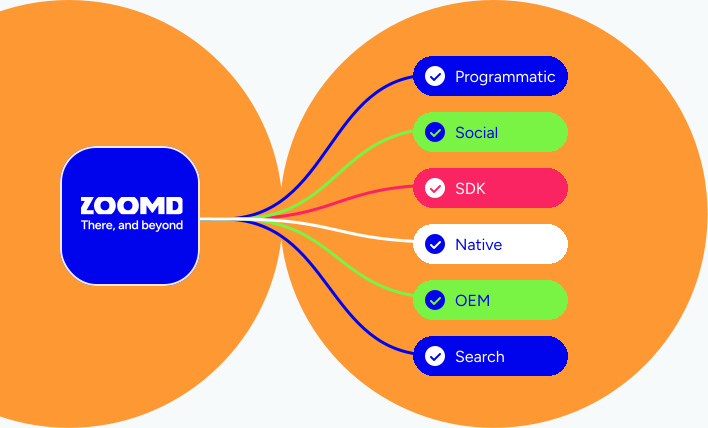
Platforms like Zoomd Networks, our proprietary user acquisition platform, enable marketers to reach audiences across hundreds of media sources while maintaining a centralized performance view.
- Centralized performance visibility
Rather than managing promotion channel by channel, leading teams work from a unified environment where performance signals can be compared, prioritized, and acted on.
This is where an integrated DSP, connected to premium exchanges, plays a critical role, allowing marketers to evaluate inventory quality, delivery efficiency, and engagement patterns in one place.
- Continuous optimization logic
Optimization isn’t an action but a process. Mature app promotion systems rely on real-time performance feedback to adjust budgets, pacing, and priorities continuously.
Cross-channel decisioning platforms like Albert.ai help automate this layer, allocating budgets across search, social, and programmatic based on live performance signals without relying on static rules or manual guesswork.
- Alignment with post-install outcomes
Installs are the beginning, not the goal. The most effective app promotion systems feed post-install data back into acquisition decisions, ensuring that growth is driven by value not volume.
App promotion KPIs that matter at scale
One of the clearest differences between early-stage promotion and systemized promotion is what teams measure.
While installs and CPI remain useful inputs, they don’t tell the full story. Performance-driven teams focus on signals that reflect long-term impact:
- Engagement quality over raw volume
- Retention patterns across cohorts
- Revenue contribution over time
- Cost efficiency relative to user value
These KPIs don’t replace acquisition metrics they contextualize them. They turn app promotion from a cost center into a growth lever.
Automation empowers rather than shortcuts
Automation is often misunderstood in app promotion. It’s not about removing human strategy; it’s about removing friction.
As budgets grow and channels multiply, manual optimization simply can’t keep up with the pace of data. Automation allows teams to:
- React faster to performance shifts
- Allocate budgets dynamically
- Maintain consistency across channels
- Free up time for strategic planning and creative development
When integrated correctly, automation strengthens decision-making rather than replacing it.
How leading teams build repeatable app promotion engines
High-performing app marketers tend to share a few operational habits:
They test systematically
Every campaign contributes learning. Tests are designed with clear success criteria and applied across channels where relevant.
They scale what works intentionally
Budget increases follow proven performance patterns, not assumptions. Scale is earned through consistency.
They govern performance centrally
Even when using multiple platforms and media sources, decision-making remains centralized. This ensures accountability and clarity.
They invest in infrastructure
Instead of chasing the next tactic, they invest in platforms and systems that make future growth easier, not harder.
From campaigns to systems: the future of app promotion
App promotion isn’t becoming simpler but it is becoming more structured.
As competition increases and expectations rise, sustainable growth depends less on isolated tactics and more on how well performance systems are designed.
Platforms like Zoomd Networks, Zoomd’s integrated DSP, and Albert.ai support this shift by enabling marketers to operate app promotion as a connected, performance-driven ecosystem, one that adapts in real time and scales with confidence.
The brands that win aren’t those running the most campaigns. The brands that see success in their UA campaign are the ones building promotion systems that keep working long after the launch phase ends.
That’s what turns mobile app marketing into a long-term growth advantage.
At Zoomd, our team is made up of seasoned media veterans who take all the above and beyond into account. We combine a deep understanding of performance metrics, long-standing relationships with top media channels, and ongoing, transparent communication among our optimization managers to consistently achieve outstanding results.
If you’re ready to drive sustainable growth and want to do it right, reach out to our expert team today.